
By Taylor Davis, Standards Lead and Secretariat, Community Coordinator
Last week, I had the opportunity to attend the Society for Standardization Professionals (SES) Annual Conference in Ottawa, Canada.
 With this being not only my first SES Conference but also my first conference out of the country, it was an amazing opportunity to engage with standards professionals from a wide range of industries. While the topics varied from artificial intelligence and digital health to accreditation and stakeholder engagement, a few common themes emerged throughout the event.
The discussions reinforced that standards development is evolving rapidly, and organizations must continue adapting while remaining focused on the people and communities they serve.
Trust Remains the Foundation
If there was one theme that appeared throughout nearly every session: trust.
Whether the discussion focused on digital health applications, interoperability, accreditation, or emerging technologies, speakers repeatedly emphasized that trust is what enables innovation. Organizations are more willing to collaborate, share information, and adopt new solutions when confidence exists in the systems, processes, and people involved.
One session focused on driving trust and innovation in digital health, highlighting the role standards play in improving information sharing and supporting better outcomes. Another speaker discussed the importance of building trust through accreditation, reinforcing that governance, transparency, and accountability remain critical as industries continue to evolve.
For those of us working in standards development, the message was clear: trust is not a byproduct of innovation, it is a prerequisite for it.
 Preparing Standards for the Future
The conference opened with a keynote focused on future-proofing standardization and maintaining global relevance in a rapidly changing world. Chantal Guay, Chief Executive Officer of the Standards Council of Canada, challenged attendees with a question that resonated throughout the week: “Are we going to shape change or be shaped by it?”
That theme was reinforced during a pre-conference workshop, Mapping the Standards Landscape: Techniques and Tools, led by Christine DeJong Bernat, Associate Director, Standards Facilitation for American National Standards Institute (ANSI) and Karen Reczek, Social Scientist with The National Institute of Standards and Technology (NIST). The workshop explored how organizations can better understand the standards ecosystem around them, including standards dependencies, overlapping activities, participation across standards development organizations, and opportunities for collaboration.
One takeaway that stood out to me was the importance of understanding not only the standards an organization develops, but also how those standards interact with products, operations, and the broader community. Discussions focused on defining scope early, identifying where standards overlap, and ensuring standards remain practical and operational for the people who use them. Participants were encouraged to think strategically about how standards landscapes can help organizations stay informed, engage stakeholders, and better coordinate efforts across industries.
Many conference discussions also centered on machine-readable standards and ensuring frameworks can work together. As technology continues to evolve, successful standards development will require organizations to “understand where they should lead, where they should collaborate, and where they should follow” – more wise words from Chantal Guay.
 AI’s Growing Role in Standards Development
Artificial intelligence (AI) was another major topic across multiple sessions.
Speakers explored how AI can help accelerate research, content development, and standards creation. The goal is not simply to create standards faster, but to move from static documents toward more accessible and usable knowledge. Discussions also highlighted the growing importance of machine-readable standards and the opportunities AI presents for improving how standards are developed and consumed.
At the same time, conversations frequently returned to validation and verification. While AI offers significant opportunities, human expertise remains essential to ensure quality, accuracy, and consensus.
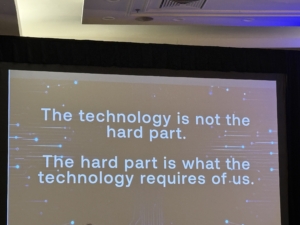
As someone who works closely with standards volunteers and subject matter experts, I found myself wondering how organizations will balance efficiency with oversight. The technology is advancing quickly, but trust in the resulting standards will still depend on strong review processes and expert participation.
Having a Voice at the Table
Another recurring theme was stakeholder engagement.
Several sessions emphasized the importance of bringing diverse perspectives into standards development and understanding challenges from business, technology, policy, and operational viewpoints. Speakers encouraged attendees to stay ahead of change by engaging stakeholders early and helping shape solutions before barriers emerge.
A phrase I heard repeatedly throughout the conference was the importance of “having a voice at the table.” Standards are strongest when the people affected by them have the opportunity to contribute their expertise and experiences. Effective engagement not only improves standards, but also helps ensure they remain relevant and widely adopted.
This theme was echoed again during discussions on resilience and emergency management, where speakers highlighted the importance of coordination, integration, and communication. Regardless of the industry, meaningful progress requires collaboration.
Final Thoughts
As I reflect on the SES Conference, I am struck by how connected these themes were. Trust enables collaboration. Collaboration strengthens standards. Standards support innovation. And innovation requires organizations to continually adapt while keeping stakeholders engaged.
The conversations throughout the conference reinforced that the future of standards development will be shaped not only by technology, but by the communities that come together to build consensus, share expertise, and create solutions that serve everyone. As standards professionals navigate emerging technologies and evolving industries, the opportunity remains the same: to actively shape the future rather than simply respond to it.
